Reviews
Reader Reviews
“So tomorrow I’m going with Joe Kennedy Jr. to the fanciest, swankiest restaurant in London.”
Barbara never felt more alive than when she was pretending to be someone else. Acting was not merely a passion but an awakening. When the letter arrived awarding her a scholarship to the Royal Academy of Dramatic Art, she believed—without hesitation—that the future she dreamed of was finally within reach.
For a brief, glittering moment, that future materialised. She found herself on film sets, moving across the silver screen beside celebrities like the charming Charles Farrell. The glamour of the studio lights, the hum of whispered excitement, the intoxicating sense of belonging among rising stars—all of it made her feel invincible.
Yet it was on the set of The Ship’s Bell that her world shifted irrevocably. Joe Kennedy Jr. entered her life with the ease of someone who knew he belonged anywhere. Handsome, affable, and surrounded by an air of effortless promise, he carried a smile so bright it seemed to illuminate the entire room. Barbara felt herself drawn toward him with a mixture of curiosity and daring hope. She could, she thought, easily lose her heart to a man like that.
But the world beyond London’s theatres was darkening. War hovered at the edges of everyday life, inching closer with each newspaper headline. Determined not to remain a bystander—just as her steadfast brother Kent had refused to—Barbara joined the Voluntary Aid Detachment. Glamour was quickly replaced by bandages, exhaustion, and a new understanding of courage.
As the Blitz thundered over London and the sky glowed with an orange fury, she found herself standing before the most agonising crossroads of her life: should she risk the perilous journey to America, aware that her mother would leave London and return to the family home in Somerset? Or remain in the capital, a target of unrelenting air raids and a potential German invasion?
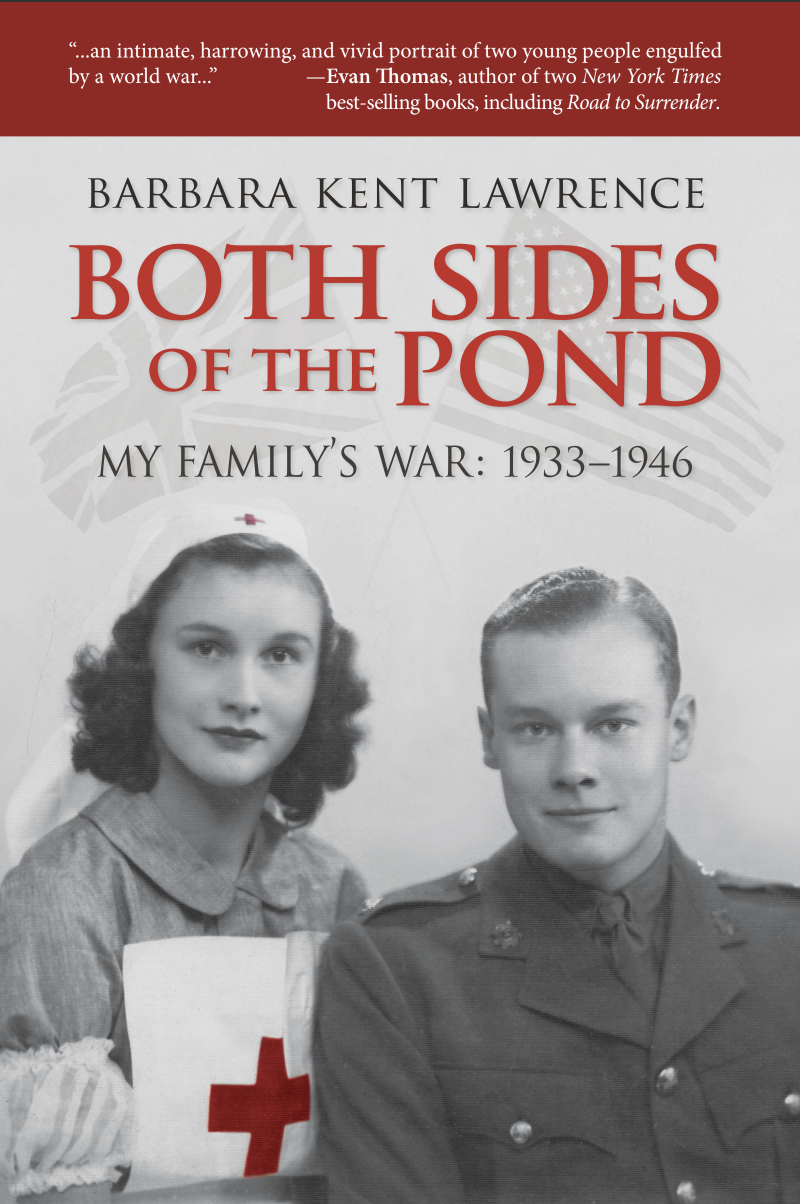
Barbara Kent Lawrence’s “Both Sides of the Pond: My Family’s War, 1933–1946” chronicles these moments with piercing clarity. Through the intertwined stories of Barbara Green(e), a determined young actress, and her brother Kent, a compassionate soldier, Lawrence weaves a vivid memoir that balances personal struggle with the sweeping tides of history. The result is a narrative that captures the heartbreak, resilience, and transformation of a family navigating one of the most tumultuous eras of the twentieth century.
Presented as a historical fiction biography, the work masterfully merges rich storytelling with photographs and detailed timelines that anchor the reader in the period. The images deepen the emotional resonance, offering glimpses into the lives behind the words, while the timelines trace events with precision, guiding the reader through global conflict and personal evolution.
The story begins with Barbara’s acceptance to RADA—a moment brimming with promise—and soon shifts to the looming threat of war. What follows is an unflinching depiction of Europe descending into chaos: the uneasy lull of the Phoney War, the sudden brutality that follows, and the desperate retreat to Dunkirk, where survival becomes an hour-by-hour endeavour. The narrative maintains a steady rhythm, balancing charged scenes of combat with quieter moments of introspection, grounding the reader in both the physical and emotional battlefield.
Kent’s journey through these chapters is as compelling as it is harrowing. A thoughtful and principled young officer, he faces the grim realities of war with integrity but not without fear. His private doubts, laid bare through reflective passages, reveal the psychological weight he carries. These vulnerabilities do not diminish him; instead, they illuminate the courage it takes to remain human in a world tearing itself apart.
Barbara’s path diverges across the Atlantic as she boards a ship bound for America—a voyage shadowed by the constant threat of U-boats prowling beneath the waves. In this new land, she must rebuild her life while wrestling with uncertainty and hope. Her internal voice becomes a source of strength, allowing readers to see her fears, determination, and longing as she confronts both external danger and private dreams.
Her relationship with Joe Kennedy Jr. forms one of the memoir’s most tender and heartbreaking threads. Swept into the promise of romance, Barbara imagines a future that feels achingly within reach. But Joe, burdened by his family’s expectations and the complex world he inhabits, would never offer her the life she envisions. The truth arrives not through his voice, but through his mother’s gentle honesty—a revelation that shatters Barbara’s hopes while exposing the quiet tragedy of unbalanced love.
Lawrence’s descriptive power brings each setting alive with cinematic clarity. One moment, readers stand with Barbara beneath theatre lights; the next, men are filling sandbags in Regent’s Park. The ruined Belgian towns appear like ghosts on the page, the screams of children echoing with what once was. Dunkirk becomes a fevered landscape of smoke, shouting, and fear—its shoreline both a trap and a lifeline. Even the voyage aboard the Warwick Castle is rendered with meticulous detail, the vast Atlantic stretching outward in all directions as danger lurks beneath the waves.
Through all of these vivid scenes, the characters’ emotions remain the story’s beating heart. The memoir’s prose invites the reader to share in their terror, their courage, their fragile hopes, and their small victories. By the time the final pages turn, Barbara and Kent feel like companions—individuals whose journeys linger long after the book is closed.
This is a story of war, but also of artistry, ambition, heartbreak, duty, and the enduring strength of family. It is a story that stays with you long after you have closed the book.
Goodreads Community Review
Author Barbara Kent Lawrence weaves a rich tapestry of the lives of her British mother and uncle from 1933 to 1946, before, during, and just after World War II.
The London siblings are in their early twenties when war is imminent, and then a reality. Barbara Green (Stage name: Barbara Greene) is a successful young actress, and Kent Green is an accountant. Before the war begins, Barbara meets Joseph Kennedy, Jr., son of the U.S. Ambassador to England, Joseph Kennedy, Sr. They develop a relationship, and as the war rages, Ambassador Kennedy facilitates Barbara’s passage to the United States to escape the hostilities and shield her from a German victory over her country, if England is defeated.
In the early years of the war and despite their burgeoning careers, Kent and Barbara heed the call to national service. Barbara, finding it difficult to find acting work, joins the Voluntary Aid Detachment (VAD) and is trained to care for sick and injured patients. Kent enlists in the Army Service Corps (RASC), and, as an officer, manages the procurement and distribution of supplies to front-line troops.
Through letters written by Barbara, Kent, their mother Muriel, and others, we learn how people coped with loneliness, injury, and grief, as friends, families, and places are devastated. One can easily sense the loving relationship between Kent and Barbara, and see how they mature.
The author creates vivid images of Barbara’s voyage to the United States, the passengers’ fears of German U-boat attacks on their ship, and trepidations about starting life in America. As the war rages in England and the rest of Europe, America offers a place of peace, opportunity, and solace for Barbara, until Pearl Harbor is attacked and America joins the conflagration.
Alternating between Barbara’s war on the west side of the Atlantic, and Kent’s on the east side, we see these siblings find love, lose love and loved ones, face fear, and survive. Besides the engaging prose and realistic dialog, photos, charts, letters, diary entries, diagrams, and documents support the story’s events and human drama within the historical context of the time. The book is well-researched, easy to read, and includes all the necessary references, attributions, and notes.
The author identifies the story as “historical fiction,” and it falls well into the parameters of creative nonfiction—a true story created in the style of fiction and told against the backdrop of a specific period in time.
War stories are very personal. This is such a story, and it offers insight into how two young people navigated difficult years that altered the trajectories of the lives they thought they would live. It is a worthy read, written beautifully. Don’t miss it.